 Menu
Menu

 Call Us








4 ways digital signage improves patient communication in health centres and hospitals
If you’re responsible for how a hospital or health centre runs day to day, you already know how much of that experience comes down to communication. Not in a broad sense, but in the small, constant interactions that happen across reception desks, waiting areas and corridors.
Everyone has sat in a waiting room at some point. You watch the door, listen for your name, wonder if things are running late and quietly check whether you’ve missed something. Now scale that up across hundreds of patients, every single day, and you start to see where the pressure sits.
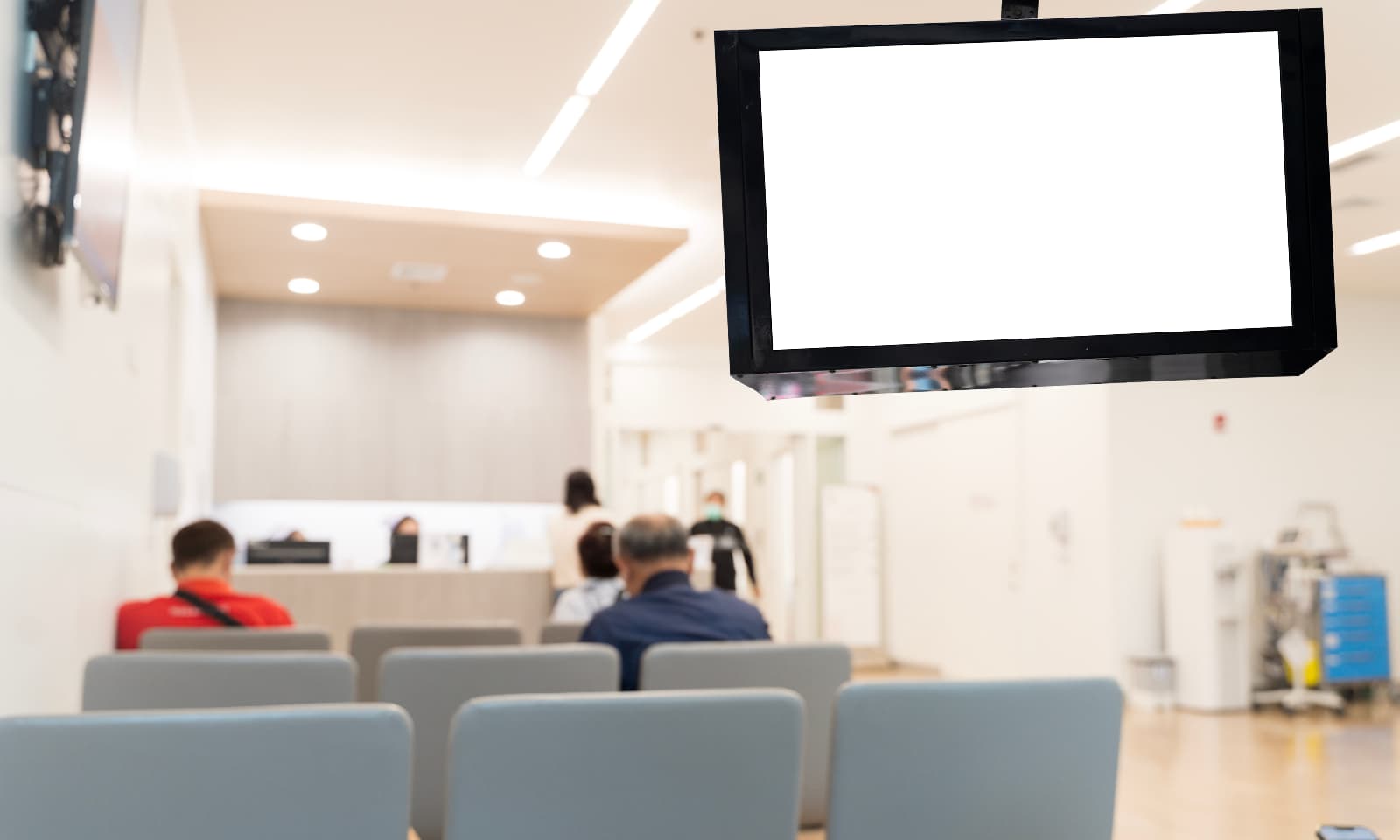
Most of the time, the systems in place are doing exactly what they’re supposed to do. Staff are keeping things moving, answering questions and guiding people through the process. Indoor digital display screens don’t replace that. It simply supports it by making important information visible where people are already looking.
Real-time information changes how patients experience the wait
If you think about your own experience in a waiting area, the frustration rarely comes from the wait itself. It comes from not knowing what’s happening around you. You start to question whether things are running late, whether you’ve missed your name being called, or whether you’re even in the right place.
That uncertainty is where pressure builds, both for patients and for staff. It leads to people checking back in at reception, watching for cues from others, or trying to piece together what’s going on from limited information.
Making that information visible changes the dynamic. When updates on delays, queue progress or room changes are clearly displayed, patients don’t have to rely on catching someone at the right moment to stay informed. They can check their position in the process themselves and carry on waiting with a clearer sense of what’s happening.
From your side, this tends to show up in more practical ways. Reception teams deal with fewer repeat questions, interruptions become less frequent, and the waiting area feels more settled even during peak times. The underlying process hasn’t changed, but the way it’s communicated has, and that shift makes the entire experience easier to manage.
Navigation becomes part of the environment, not an extra step
Wayfinding is something every healthcare environment already has to manage, and in most cases, it’s already carefully thought through. You’ve got wall signage, directories, colour coding, and staff supporting patients when needed. It works, but it still relies quite heavily on people stopping, scanning their surroundings and working things out as they go.
If you watch how patients move through the building, you’ll see where the friction sits. People pause at junctions, double back when they’re unsure, or stop a member of staff just to confirm they’re heading in the right direction. None of that is a major issue on its own, but across a full day, it adds up and interrupts the natural flow of the space.
When directions are displayed on indoor digital screens and positioned at the points where decisions are being made, the process becomes more immediate. Patients don’t have to search for information or second-guess what they’ve read earlier. They can follow clear prompts as they move, which makes the experience feel more straightforward from their point of view. From an operational perspective, it reduces the small but constant interruptions your teams deal with. Fewer people stop to ask for directions, and movement through the building becomes more consistent.
Multilingual communication reflects the communities you serve
In most healthcare settings, you’re not dealing with a single, uniform patient group. The communities you support are varied, and that often includes a wide range of languages and different levels of confidence with written English. That reality is already factored into how services are delivered, but maintaining consistent communication across those differences isn’t always straightforward.
Printed signage can only go so far. Trying to cover multiple languages often leads to overcrowded noticeboards or separate materials that aren’t always seen at the right time. Even when the information is there, it still relies on patients finding and recognising what’s relevant to them.
Our LED message boards give you more control over how that information is presented. The same message can be delivered across multiple languages in a structured way, rotating naturally across screens without overwhelming the space. It means key instructions, updates and guidance are more likely to be seen and understood in the moment they’re needed, rather than being missed or misunderstood.
From a practical point of view, that reduces small breakdowns in communication that can otherwise carry through the entire visit. Fewer missed steps in check-in, fewer clarifications needed at reception, and a more consistent experience for patients regardless of language.
Health information is more likely to be seen when it feels current
Most healthcare environments already put a lot of effort into sharing useful information with patients. Posters, leaflets and noticeboards are all there for a reason, but over time they tend to become part of the background. Even when the content is relevant, people stop noticing it because it doesn’t change often or doesn’t feel connected to what’s happening around them.
That’s where digital signage shifts things slightly. When the same type of information is presented on screens, it sits alongside the operational content patients are already paying attention to. Updates, directions and queue information naturally draw the eye, and health messaging becomes part of that same flow rather than something separate that has to compete for attention.
It also gives you far more control over how current that information feels. Seasonal advice can be updated as needed, campaigns can be introduced and removed without delay, and messaging can be adjusted depending on what’s most relevant at that moment. That might be something broad like winter health guidance, or something more specific to a department or service.
From your perspective, it means the effort you’re already putting into patient education starts to carry further. Information is more visible, more timely and more likely to be taken in without needing additional explanation. It becomes part of the environment patients are already engaging with, rather than something they have to actively look for.
If you’re reviewing how communication works across your site, or you’ve got a specific challenge in mind, we’re always happy to talk things through. At Scanlite, we’ve got 40 years of experience delivering digital displays across everything from small local pharmacies and private clinics to large hospitals and specialist medical facilities.
Whether it’s LED message boards, LED programmable signs for the waiting area or indoor digital display screens, we offer digital displays for healthcare that fit naturally into your space and support both patient experience and operational flow. To get started, you can request a quote or give our team a call today on 01253 302 723 and we’ll be happy to help.